

Two Masters of Search: Navigating the Unique Google vs. Bing Dynamic in the UAE
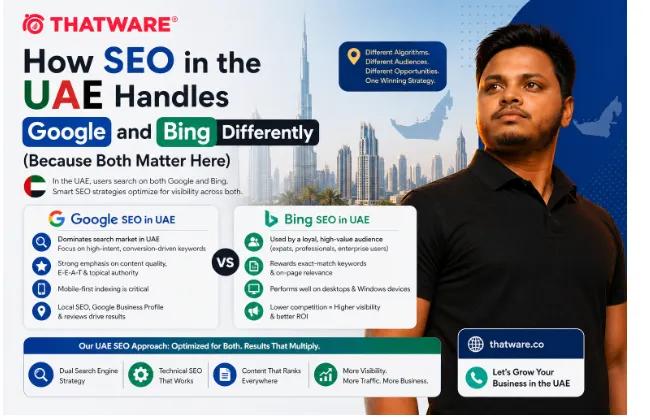
When deploying a digital marketing strategy in the Western world, the search optimization playbook is almost exclusively written for Google. With a staggering global market share, optimizing for any other search engine is frequently treated as an afterthought.
However, brands attempting to copy-paste this Western approach into the United Arab Emirates (UAE) quickly run into an expensive wall.
The UAE presents one of the most unique, digitally advanced, and diverse search landscapes in the world. Driven by a massive expatriate corporate workforce, high-tech infrastructure, and a dual-language ecosystem, Bing is not an alternative in the UAE—it is a critical revenue driver.
To build a truly dominant organic footprint in the Emirates, brands must look beyond the standard single-engine strategy. Advanced search intelligence firms like ThatWare are re-engineering Middle Eastern digital strategies, proving that capturing the high-value UAE market requires a dual-framework approach built to satisfy both Google and Bing simultaneously.
Why Bing Commands Unprecedented Power in the UAE
To understand why the UAE market deviates so sharply from global norms, you have to look at the region's corporate and demographic infrastructure:
The Corporate PC Dominance: The UAE, particularly Dubai and Abu Dhabi, serves as the global or regional headquarters for thousands of multinational enterprise corporations. The vast majority of these corporate offices deploy Windows-based enterprise ecosystems. Because Microsoft Edge is the locked-in, default browser across these massive enterprise networks, an immense volume of B2B and high-income commercial search traffic happens natively on Bing.
The Power of AI-Driven Search: The tech-savvy population of the UAE has been incredibly quick to adopt generative AI technologies. Bing’s deep integration with OpenAI features has triggered a massive wave of conversational search adoption among UAE professionals, drawing high-intent users away from traditional search formats.
The Operational Divide: How Google and Bing Function Differently in the UAE
Optimizing for the UAE requires treating Google and Bing as two entirely different algorithms with distinct preferences, technical demands, and ranking signals.
1. Keyword Processing vs. Explicit Semantics
Google: Google’s RankBrain and advanced NLP systems rely heavily on deep contextual understanding. Google looks at the overall theme, user search history, and abstract intent.
Bing: While highly sophisticated, Bing still places a significantly higher emphasis on explicit, exact-match keyword phrases in page titles, URLs, and H1 tags. If a corporate decision-maker in Dubai searches for "enterprise cyber security solutions dubai," Bing expects to see those precise structural markers to rank a page confidently.
2. The Language and Localization Matrix
The UAE is a multi-lingual hub where English and Arabic constantly intersect.
Google: Excels at automatically connecting the contextual dots between English and Arabic search intents, often serving localized results even if the query phrasing is slightly blended.
Bing: Demands clean, mathematically precise technical localization. To rank well on Bing UAE, websites must deploy flawless hreflang tags, explicit schema markups, and clear regional indicators within the Microsoft Webmaster Tools dashboard.
3. Backlinks vs. Social and Multimedia Signals
Google: Continues to place foundational weight on deep backlink profiles, focusing on the domain authority and historical trust of the websites linking to you.
Bing: Puts a disproportionately higher emphasis on direct social signals, active user engagement metrics, and high-quality multimedia elements (like optimized images and videos) directly embedded on the webpage.
Engineering a Unified Dual-Engine Strategy for the UAE
Because both search engines capture different segments of the high-purchasing-power UAE demographic, a fragmented optimization strategy is a major competitive disadvantage. By utilizing advanced search systems, ThatWare helps brands construct a unified framework that satisfies both masters:
Step 1: Write Contextually, Structure Explicitly. Craft content that reads naturally, answers complex user intent, and builds topical authority (for Google). Concurrently, ensure that exact-match target keywords are precisely placed in the meta architecture, URL paths, and primary headers (for Bing).
Step 2: Claim and Optimize Dual Dashboards. Never treat Google Search Console as your only data source. Maximize visibility by claiming, verifying, and actively submitting index requests through Bing Webmaster Tools, ensuring your regional UAE targeting is manually configured across both platforms.
Step 3: Leverage Local Multimedia and Engagement. Build highly interactive pages featuring localized videos, imagery, and clear schema data. This satisfies Bing’s preference for rich, engaging media assets while simultaneously lowering bounce rates, which implicitly improves Google rankings.
By breaking away from traditional, one-dimensional SEO assumptions and respecting the unique power balance between Google and Bing, brands can effectively capture the full spectrum of the UAE’s lucrative digital market.